About HEART
The History of HEART
HEART – Herning Museum of Contemporary Art emerged at the intersection of art and industry. Its foundation was laid by the passionate shirt manufacturer Aage Damgaard (1917–1991), whose visionary art collection became the cornerstone of the museum.
Founded as Herning Art Museum in 1977, the museum moved into a new building designed by the American architect Steven Holl and opened on 9 September 2009. On the occasion of the inauguration, the museum adopted its current name: HEART.
Founder and Art Patron
Aage Damgaard (1917–1991) was a renowned shirt manufacturer from Herning who achieved great success with his Angli shirt company. At Damgaard’s Angli factories, a vibrant artistic environment flourished, shaped by a number of experimental Danish and international artists whom he invited to create new works within the setting of a modern industrial workplace.
Artists such as Piero Manzoni, Robert Jacobsen, Paul Gadegaard, Svend Wiig Hansen, Sven Dalsgaard and Carl-Henning Pedersen came to Herning and transformed the cultural life of the city.
“Can This Really Be Art?”
Damgaard’s collaborations with artists attracted considerable public attention and sparked heated debate. Newspapers across Denmark, as well as the local Herning Folkeblad, published countless articles and letters to the editor criticizing what some saw as “all the rubbish Herning had to put up with.” The question was frequently asked: “Can this really be art?”
Yet the bold and innovative artworks reflected the same spirit of experimentation and ambition that characterized the rapidly expanding textile industry in its pursuit of new possibilities and progress.
The Importance of Art to Damgaard
During his career as a manufacturer, Damgaard assembled a remarkable and unique art collection. He was also one of the driving forces behind Herning becoming synonymous with some of the most progressive contemporary art of the 1950s and 1960s.
At the time, no one could have imagined that the “crazy ideas of the eccentric shirt manufacturer” would one day form the backbone of the collection of a state-recognized museum of contemporary art.
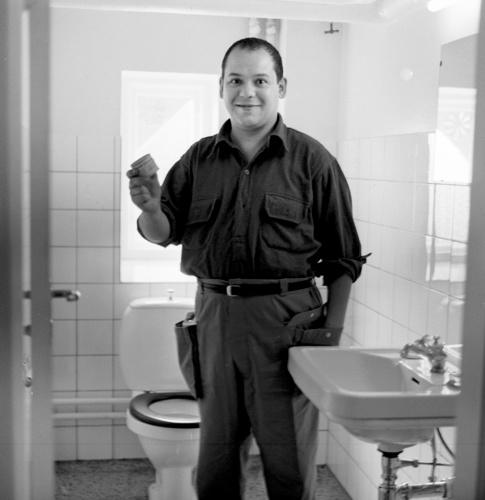
Piero Manzoni with his seminal work Merda d’Artista (1961). Photo: Ole Bagger.
A Creative Playground
Damgaard employed artists to create works at his factories, giving them complete artistic freedom and the peace and space needed to work. Being invited to work as an “Angli artist” meant that Damgaard covered salary, accommodation, meals, studio facilities, materials, and practical assistance.
In return, the majority of the artworks created during these residencies became part of Damgaard’s collection.
Close Relationships with the Artists
Many artists stayed with the Damgaard family, where Aage’s wife, Bitten Damgaard, and the couple’s five children formed the centre of family life. Others—such as Piero Manzoni—stayed in local hotels in Herning.
There is little doubt that the Damgaard family’s life was profoundly influenced by art and by the friendships that developed during these visits. The conversations, companionship, and unique atmosphere that accompanied the artists’ presence became a source of inspiration and vitality for Damgaard. In many ways, the education he had missed during his early years—when dyslexia made formal schooling difficult—was found through these encounters.
Damgaard’s Motivation
Damgaard’s artistic projects and the decoration of his many factories were also driven by a sincere desire to improve working conditions for seamstresses and other factory employees. Workplace wellbeing and a positive working environment went hand in hand with sound business practice. At the same time, the publicity generated by these artistic initiatives contributed to the growth of the Angli company.
“While art gives me great pleasure, I also regard it—and I make no secret of this—as good business (...) People do not become dulled when they have great art before their eyes. Whether they like it or criticize me, I do not care. As long as I can shake people up. Make them feel outrage or enthusiasm.”
— Aage Damgaard